The quiet majority
Water
Minerals shape softness, crispness and the way bitterness lands on the palate.
An independent field guide
Beer begins long before the first pour — in soil, grain, weather, patient hands and the invisible work of yeast.
Beer culture
& good company
The journey
Four ingredients.
Endless outcomes.
Every glass is a meeting of agriculture and alchemy. A brewer can change the grain, the water, the timing or the temperature — and send the same four ingredients in a completely new direction.
Grown. Brewed. Poured. Shared.
01 — In the beginning
Simple on paper.
Infinite in practice.
The quiet majority
Minerals shape softness, crispness and the way bitterness lands on the palate.
Grain, transformed
Barley brings fermentable sugar, body and a spectrum from fresh bread to dark cocoa.
The garden's signature
Resin, citrus, herbs and spice arrive from a small cone filled with aromatic lupulin.
The living ingredient
A microscopic culture turns wort into beer and leaves its own expressive fingerprint.
02 — The brewhouse
Brewing is less a recipe than a chain of decisions. Each step leaves a trace in the finished glass.
Grain is gently crushed, opening the kernel while keeping its husk.
Warm water wakes the enzymes that convert starch into fermentable sugar.
Hops meet the wort; bitterness, aroma and structure begin to find balance.
Yeast does the invisible work, creating alcohol, carbonation and character.
Time rounds the edges. The beer clarifies, settles and becomes itself.
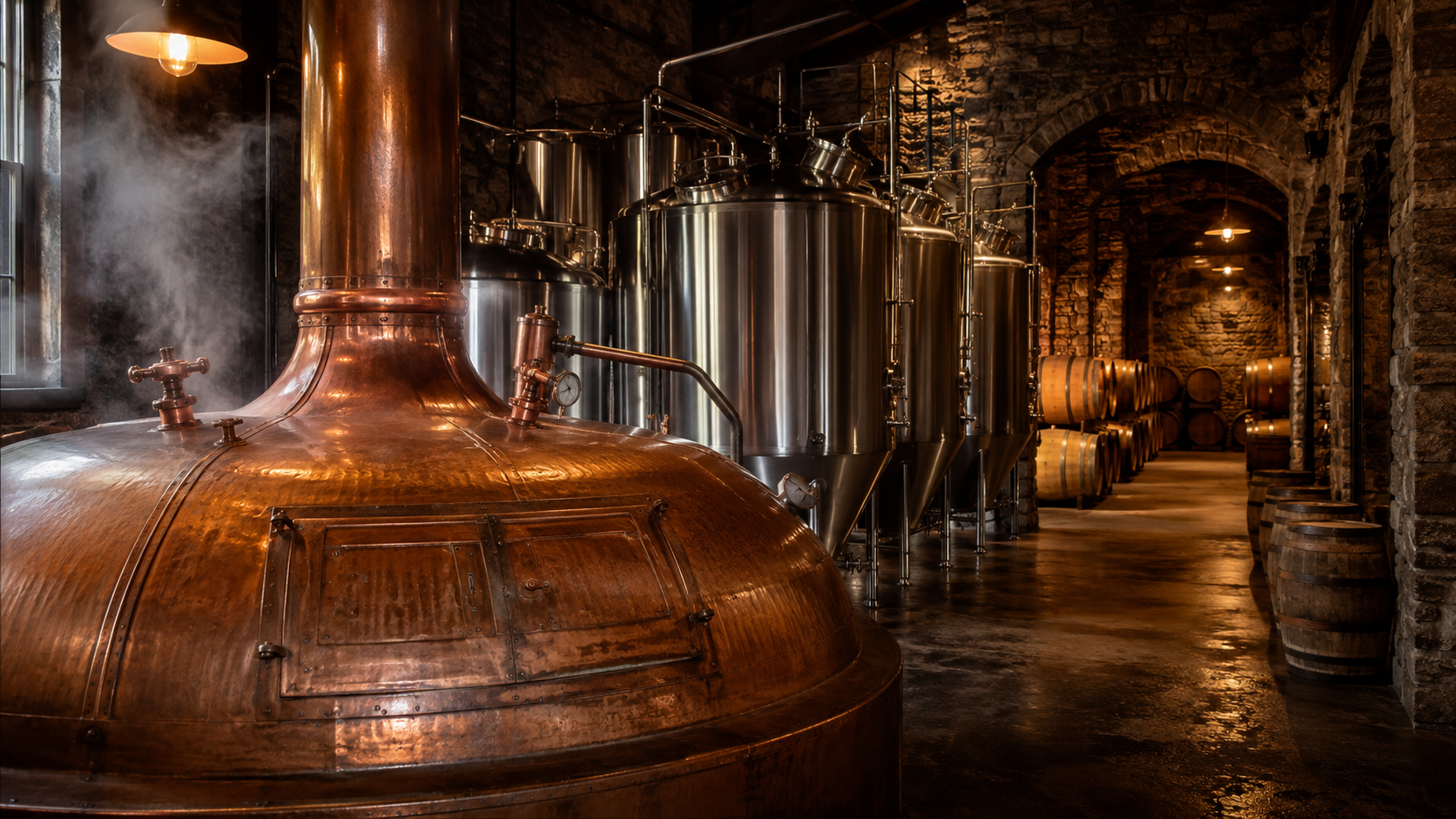
03 — Patience
Fermentation is only the beginning. Rest allows flavours to settle, harsh edges to soften and carbonation to become part of the beer rather than something sitting on top of it.
Slow maturation at low temperature produces a clean, composed profile.
Oak can bring vanilla, tannin, oxidation and traces of what the barrel held before.
A final fermentation in the bottle creates natural carbonation and continuing change.
04 — A world of styles
Style names are useful maps, not walls. Ingredients, place and technique always leave room for interpretation.
Crisp · floral · dry
Pale, bright and precise. A clean fermentation lets grain, noble hops and a firm finish speak clearly.
Balanced · citrus · biscuit
A meeting point between expressive hops and a steady malt backbone, usually gold through copper.
Hoppy · resinous · vivid
Built around hop aroma and flavour — from grapefruit and pine to tropical fruit and fresh herbs.
Dry · peppery · lively
Highly expressive yeast, brisk carbonation and a rustic grain character make this a restless, refreshing beer.
Roasted · coffee · cocoa
Dark malt creates flavours that can move from dry espresso to chocolate, caramel and a full, soft finish.
Tart · fruity · complex
Acidity and fermentation share the lead. The result may be clean and bright or deepened by fruit, oak and time.
05 — A very long story
Beer has changed with agriculture, cities, trade, refrigeration and taste. Its oldest constant is remarkably simple: people gather around it.
Late 4th millennium BCE
Residues found on ancient vessels show that fermented grain drinks already belonged to everyday and ritual life.
Middle Ages
Across Europe, brewers refined repeatable methods while hops gradually became central to aroma, bitterness and keeping quality.
1842
A clear, golden lager brewed in Pilsen changed the world's expectation of how beer could look and taste.
Late 20th century
Independent brewers revived neglected traditions and pushed hop character, fermentation and barrel ageing in new directions.
06 — The ritual
Very cold hides aroma. Delicate lagers like a chill; dark and complex beers usually reveal more as they gently warm.
Shape guides foam and aroma. More important than ceremony: a glass should be clean, cool and generous enough for a proper head.
Tilt first, then straighten. A controlled crown of foam releases aroma and gives carbonation somewhere graceful to go.
The oldest serving rule needs no equipment: slow down, pay attention and leave room at the table for someone else.

07 — Good company
Stay curious. Share the table. Enjoy thoughtfully.
Twilight / the garden / one more round of conversation